The Best Innovation & Creativity Books of 2025
From the most minute day-to-day tasks as a one-person startup entrepreneur to predicting the future, these ten books will help you be more creative, discerning, skeptical, empathetic, responsive to change, and visionary. Learn about each in the reviews by Porchlight's Creative Director Gabriella Cisneros.
In 2006, the internet allowed us to feel more in control of our own narratives than ever before. Digital cameras were cheap enough that I, at 10 years old and without even an allowance, could afford one. YouTube had launched a year earlier, offering everyday individuals turns in the limelight. The Time Person of the Year was “You. Yes, you. You control the Information Age. Welcome to Your World.”
20 years' worth of alternative facts, blogs, memes, clickbait headlines, digital entrepreneurial endeavors, and cheap products later, and the internet looks a bit like a landfill sometimes.
Here we are in 2026, and the internet, and technology in general, is determining a lot about the state of our world. Technology is magnifying both the good and bad sides of humanity. As Laura Bates writes in The New Age of Sexism:
“We’ve arrived at a critical moment. We are building a whole new world, but the inequalities and oppression of our current society are being baked into its very foundations. And if the harassment and violence that have blighted the lives of women and minoritized communities for centuries are being coded into the fabric of the future systems, environments, and programs that will form the basis of all our lives over the coming decades, unraveling those forms of prejudice is going to become a million times harder. Worse, that prejudice might become entrenched and even exacerbated, dragging the most vulnerable in our society backward as we supposedly hurtle forward into a glittering new world.”
However dark the world looks—both on our screens and outside of them—the power to fix real-world problems can be gathered and galvanized via digital platforms. So there is real worth in fixing our digital worlds. And we as individuals have that power.

The expectations we have for technology’s safety must not fall on deaf ears, so several of the books on this year’s Innovation & Creativity longlist (especially Raising AI, The New Age of Sexism, Could Should Might Don’t, The Future of Storytelling, The Uncanny Muse, and Digital Culture Shock) provide guidance for those in careers that play a part in building technology.
All of the books we honor with our Awards are important, but I believe the books on the Innovation & Creativity list are especially urgent this year. Technology is changing rapidly, and we can’t let it outrun ethics. As Nick Foster puts into perspective the rapidity of technological progress in Could Should Might Don’t:
“Our generation is experiencing technological and societal change at a rate and magnitude not felt by our ancestors, and the effects of this change can be bewildering. Alvin Toffler defined this feeling as ‘future shock’ in his seminal 1970s book of the same name, describing a psychological state of dislocation and disorientation experienced by individuals—and entire societies—that is brought about by 'too much change in too short a period of time.'”
The best Innovation & Creativity books of 2025 are for those wanting to feel empowered rather than disoriented by technology. But they're also a reminder to keep humanity a part of our technological endeavors.
While it’s important to act quickly when it comes to correcting the inequalities currently being baked into technology, there are many of us that do not (or should not) rely on AI or other technologies to do our best work. So, among the technology- and future-focused narratives are a few books with more grounded subject matter that present better ways to do traditional creative tasks: The Storyteller’s Advantage, Pioneers, The Sweaty Startup, and The Creative Shift will inspire successful entrepreneurial endeavors and help you create marketing campaigns that stand out.
From the most minute day-to-day tasks as a one-person startup entrepreneur to predicting the future, these ten books will help you be more creative, discerning, skeptical, empathetic, responsive to change, and visionary. And we need more people like that, because as Laura Bates writes in The New Age of Sexism: "We cannot assume things will get better on their own.”

Could Should Might Don't: How We Think About the Future by Nick Foster, MCD
“Explore how you view the future, through your own lens, on your own terms. You should feel empowered to develop ways of shaping what’s out there that feel genuine to you rather than simply adopting what you think you’re supposed to say or going along with whatever gets thrust at you. But please, I urge you, do so with rigor. Get into the weeds. Get beyond the headlines, flashy images, jaw-dropping statistics, and provocative think pieces, and truly engage with the meat of the issue. Think about how an idea will actually appear in the world, and the steps through which society might need to pass in order to get there. I can’t stress this strongly enough: the more detail you can add (or the more detail you demand), the better these stories will be.”
Who are we talking about when we talk about entrepreneurs, innovators, and creatives? Essentially, we are talking about futurists: People who are both building and projecting futures through the work they do and things that they make. Author Nick Foster connects futurism to everything we do, think, and create. Could Should Might Don’t guides readers on ways to think more skeptically about what others say the future will be and more profoundly about what it can actually be.
This book pairs well with The Uncanny Muse and The Creative Shift.
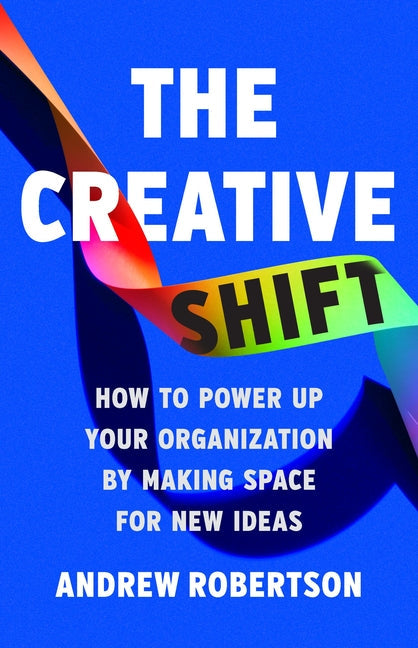
The Creative Shift: How to Power Up Your Organization by Making Space for New Ideas by Andrew Robertson, Basic Venture
“A lot of the time when you’re running a business, the very kinds of ideas and processes that make you successful are going to impede your ability to be creative.”
The Creative Shift is a fast-moving book with clear examples and advice. Plus, it offers interesting psychological findings about where, when, and how creativity thrives – information essential to creatives but also to leaders and managers. The book encourages and gives steps to support group creativity, which is perfect for leaders and managers. But there is also a lot of advice for individuals – employees and entrepreneurs – to help their creative works stand out. Written by the former CEO of the advertising agency BBDO, author Andrew Robertson has a wide purview of large-scale marketing campaigns and how they succeed (or don’t).
This book pairs well with Could Should Might Don’t and The Sweaty Startup.
Digital Culture Shock: Who Creates Technology and Why This Matters by Katharina Reinecke, Princeton University Press
“It is a moral obligation to treat everyone the same and to not disadvantage groups of people who may be unliked ourselves. Technology companies should go the extra length to find out how the technology products that they make money with might negatively impact people in this world.”
A very useful and approachable book that will give you the knowledge you need to understand and reflect on the ways that technology design can impact individuals differently across the world. The author presents the problems, the pros and cons, and the path forward.
This book pairs well with The New Age of Sexism and Pioneers.
The Future of Storytelling: How Immersive Experiences Are Transforming Our World by Charles Melcher, Artisan
“When language is written down, it is stripped of the gestures, intonation, facial expressions, and responsiveness of the person giving life to the words.”
This book might be a strange choice for a book award, especially from our company which believes so deeply in the importance of the written word, but The Future of Storytelling expands the idea of a story and does a beautiful job of showing how companies can tell their stories in innovative ways. Examples include VR experiences and immersive theatre, crowd sourced video projects, and pop-up experiences.
This book pairs well with Digital Culture Shock and The Storyteller’s Advantage.
The New Age of Sexism: How AI and Emerging Technologies Are Reinventing Misogyny by Laura Bates, Sourcebooks
“Therein lies one of the biggest reasons for the problems we are seeing in AI systems that perpetuate existing inequalities: the massive pressure companies are under to create new tools and systems and roll them out before anybody else does. This arms race is reminiscent of the early days of social media—perhaps the most recent example of a huge shift in the way we live our lives—and some AI experts claim we’re poised to make all the same mistakes again. Social media was rolled out at great speed with incredibly steep development curves and user increases, following Mark Zuckerberg’s famous catchphrase: “Move fast and break things.” But the things that were broken were societal cohesion, democracy, and the mental health, in particular, of girls.“
The New Age of Sexism is a book that will push you into action. It offers a critical look at AI that encourages us to make it better, and to do so ASAP. The author explores how businesses like AI companions, sex dolls, and the Metaverse reinforce the mistreatment of women. She shares ways to allow technological progress to continue unhampered without sacrificing human safety. One example of how this could be achieved is the application of bespoke regulation and standards to any AI product released to the public, with different rules for research and development. Separating AI research from big-tech funding and interference is another potential solution. But that will require both national and international governing entities to step up in order to enact such regulation, which won’t be simple across borders and continents.
This book pairs well with Digital Culture Shock and Raising AI.
Pioneers: 8 Principles of Business Longevity from Immigrant Entrepreneurs by Neri Karra Sillaman, Wiley
“Real longevity comes from making changes that last long after your last balance sheet has been filed. Because if all you did was take money and never make a change, then all you did was worthless.”
Pioneers is composed of vibrant vignettes that introduce the future entrepreneurs as everyday people who dream of something better for not just themselves but the world around them. The narrative charts their business journey from concept to accomplishment, and author Karra Sillaman provides to-the-point takeaways from each story that can help an entrepreneur at any stage.
This book pairs well with The Sweaty Startup and Digital Culture Shock.
Raising AI: An Essential Guide to Parenting Our Future by De Kai, The MIT Press
“Their intelligence level may still be pretty weak, but, just like other kids, our AIs are already quickly learning culture from the environment we’re raising them in and the jobs we’re giving them. Our hordes of artificial children have already crept deeply into the fabric of our society.
Are you raising your AIs like any good parent should raise their kids?”
Raising AI is a very approachable book for those who want to learn about AI – its tricks, its abilities, its defects – and how to be part of the effort to make it more ethical. Author De Kai is able to communicate very clearly and often colloquially in his presentation of thought-provoking information, questions, concerns, and prescriptions in this compact book. If you’ve been overwhelmed by the scale of the idea and unpredictability of it all, but you realize that we cannot shy away from a future with AI, you need to read Raising AI. This book is essential reading for everyone, because, like it or not, through using technology, we are all raising AI.
This book pairs well with The New Age of Sexism and Could Should Might Don’t.
The Storyteller's Advantage: How Powerful Narratives Make Businesses Thrive by Christina Farr, Basic Venture

(Winner of the Best Innovation & Creativity Book of 2025)
As booksellers, we of course know the power of a good story.
Storytelling is an age-old skill that isn’t reserved for authors or parents trying to get small children to go to sleep. Storytelling is at the core of every product, idea, argument, life. Many times, we are only able to understand new information thanks to good storytelling.
Christina Farr, a former journalist and current health-tech investor and advisor, asserts in The Storyteller’s Advantage that storytelling is a skill that all sectors of a company should learn. And telling a good story goes beyond rehashing a company’s history or verbalizing a company’s mission and values.
What makes this book comprehensive is that when you learn what and how to achieve good storytelling, you will know how to improve multiple elements of your business: from the layout and language on your website to the angle of the sales pitches you give to the PR articles you pitch. What makes this book especially relevant is that it emphasizes a skill that humans and only humans can possess and use:
“Authenticity, hands down, is the trait that the best storytellers I've interviewed have in common. It gives audiences a sense that they're connecting with a real human, not just a collection of slogans or safe messaging points developed by a marketing department or an Al chatbot.”
The case studies are thoroughly explored and diverse, showing how so many different companies have stood out from the competition by prioritizing communication and storytelling: Alex Ohanian (Reddit’s co-founder and founder of the venture capital firm Seven Seven Six), Aaron Levie (CEO of Box), Laura Modi (Co-founder and CEO of Bobbie), Heidi Zak ( CEO of Thirdlove), Claire Vo (chief product officer at LaunchDarkly), and others.
Farr provides excellent advice for business leaders regarding building relationships with media early in a company’s life, how to pass on the storytelling torch, and how to continue being a part of media outreach even if it is not your sole job. She also shares seven basic plots to help you decide the route you want to take when you start telling your own company’s story.
“At the core of good storytelling lie humor, authenticity, simplicity, and surprise."
Farr’s advice is applicable to employees and entrepreneurs as well, through examples of brand building through social media posts, in team meetings, in short-form and long-form content, and more.
Farr also dissects the biases that affect the general public’s perception of business leaders, to help readers learn how to best control their own narrative.
“We know that one of the most important qualities that great storytellers share is their authenticity. Those who are authentic have an edge over those who need to be careful and coached. And yet, another way in which we hold women and people of color back is by punishing them when they are authentic, effectively preventing them from leaning into the issues they care about.”
In this way, The Storyteller’s Advantage sets realistic expectations for readers: storytelling is a skill that must be adapted differently depending on many factors of the storyteller and their business.
The Storyteller’s Advantage will help readers of any profession and with any specialization learn, adopt, and value the power of storytelling to connect with their audiences.
The Sweaty Startup: How to Get Rich Doing Boring Things by Nick Huber, Harper Business
“Most of the wealthy people in your town who are eating at nice restaurants and have memberships at fancy country clubs didn’t disrupt industries or raise venture capital. They started small, boring businesses.“
The best way to describe The Sweaty Startup is in the context of the fable “The Tortoise and the Hare.” While some entrepreneurship books encourage rethinking everything and inventing something disruptive in order to stand out from the crowd (a Hare approach), The Sweaty Startup encourages a slow-and-steady, logic-focused (tortoise-approved) strategy. Rather than “invent the next iPhone,” author Nick Huber counsels readers to start a “boring” business (lawn care, moving, residential painting, pet photography, etc.) that your community needs and offer cheaper, better, or faster service than your local competitors. There are so many refreshing qualities to this book: its succinct yet highly-informative nature, the down-to-earth and useful small businesses that it champions, and its ability to speak to entrepreneurs at every level.
This book pairs well with Pioneers.
The Uncanny Muse: Music, Art, and Machines from Automata to AI by David Hajdu, W. W. Norton & Company
“That so much of such art evokes the process of art-making itself–playing music, drawing, writing–speaks to our belief that the ability to make art is one of the attributes that makes us human. To create representations of people able to make art is to become a representation of something greater than human. It's playing God.”
In The Uncanny Muse, David Hajdu thoughtfully draws parallels across human history: from the 1979 fine art show featuring machine-generated art in San Francisco to a museum collection on mechanical music and automata in modern-day New Jersey, from a late 19th century London act featuring an art-making automaton with a female form to New York in 2023 where not much seems to have changed in regards to the fascination with art-making robots with feminine names and features. A book not completely about AI itself, but about the conditions that have led to its rise and humans’ fascination with it. Its sections about AI are accessible, likely because they focus on AI as a visual and auditory art tool – including both arguments for and against it, and many times showing us that, in some cases, we’ve already been heavily relying on technology to make art. Reading this book can help you see the shifts in technology as less extreme.
This book pairs well with The Future of Storytelling and Could Should Might Don’t.