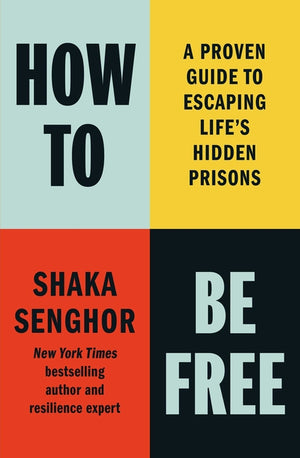
An Excerpt from How to Be Free: A Proven Guide to Escaping Life's Hidden Prisons
An excerpt from How to Be Free by Shaka Senghor, published by Authors Equity and longlisted for the 2025 Porchlight Business Book Awards in the Personal Development & Human Behavior category.
 Do you ever feel held back by self-doubt, trapped by past narratives, or paralyzed by fear of failure? These feelings are what Shaka Senghor calls Hidden Prisons—and they affect everyone, from CEOs and professional athletes to students to parents. But here's the breakthrough: these prisons have doors.
How to Be Free is a roadmap for breaking free from whatever’s holding you back.
Drawing from profound lessons he learned during his 19 years in prison—including 7 in solitary—Shaka reveals the mindset and practices that transformed his own life, and that can help anyone build their own foundation of freedom.
Through simple daily practices like journaling, meditation, mindfulness, and creative expression, he shows you how to turn your vision into action and step into your full potential—from deepening your relationships to achieving the career success you've always wanted.
In this book, you'll learn how to:
- Transform your biggest setbacks into your greatest comebacks
- Discover sustainable joy instead of fleeting happiness
- Cultivate your mindset to stay composed when everything falls apart
- Transform vulnerability into your greatest strength
- Break the cycles of grief, anger, and shame
- Protect your energy while still showing up for others
- Create your personal blueprint to true freedom
How to Be Free gives you the inspiration and practical steps to make real change feel possible. Your freedom starts now.
How to Be Free has been longlisted in the Personal Development & Human Behavior category of Porchlight Book Company's 2025 Business Books Awards. The excerpt below is from the book's Introduction.
◊◊◊◊◊
The words “Parole Denied” sat at the top of the paper I held in my hand, mocking me with this second denial. Sitting on the edge of my bunk, my perch for eighteen years, I was caught in what felt like an endless loop of confinement and disappointment. I had grown up here, transformed from rebel to writer, witnessed some friends die, some lose their mental grip, and others leave and come back. Would they ever let me out of this place?
My body tensed as I held back tears. Emotions rolled through me in waves—sadness flowing into the familiarity of anger, the kind that threatened to overtake the little hope I had left. I had ticked every box, followed the Department of Corrections’ criteria for release, and evolved in ways no one would have imagined possible. In my first five years there, I had been labeled the worst of the worst, but now I was a mentor, tutor, and writer. Back at square one, it was like being sentenced all over again.
But as I sat there, enveloped in the familiar hurricane of disappointment, a realization slowly dawned on me: I had a choice. This moment, as heartbreaking as it was, presented me with two options. I could succumb to depression, let it drag me down into that dark place of hopelessness from which there seemed no escape, or I could stand firm on the hope that had already carried me over many troubled waters and use this setback as an opportunity to prepare myself for the next hearing and, ultimately, for my freedom.
As Marcus Aurelius wrote in Meditations, “The impediment to action advances action. What stands in the way becomes the way.” This perfectly captured the transformative work I’d been engaged in for years—the work of freeing the mind, body, and soul. It was work that challenged me to embrace the present moment as both a gift and an opportunity. It’s work we all have the capacity to do.
My parole denial was an obstacle to my freedom, but within that moment lay the path forward.
I came out of that moment with renewed focus and determination. When the yard opened, I called my dad and broke the news to him. Then I walked the yard with a friend from the neighborhood and talked about what I was going to do when they released me.
When the third parole hearing finally arrived, I stood before the board not just as a man seeking freedom but as one who had already freed himself internally. I was battered and bruised but still standing. The moment I received the paperwork stamped “Parole Granted,” it was not just a release from physical confinement but a validation and manifestation of the journey I had undertaken. It was finally time for me to return to my city, community, and family. In that moment, I realized I’d been in prison before I’d ever been arrested and that I’d broken free long before the parole board saw fit to release me.
I had defied the odds, narrowly escaping the expected outcome of a kid serving a seventeen- to forty-year sentence for murder. It had been two decades since I’d last walked on free soil, unburdened by handcuffs and shackles. Despite scars from an officer nearly breaking my arm, an unhealed anterior cruciate ligament (ACL) tear from another encounter, and a bad back, my sanity, spiritual well-being, and integrity remained largely intact. Still, I struggled with feelings of self-doubt and worthlessness—vulnerabilities that could have been imperiled by release.
As I write, that was fifteen years ago, and the battle with those imprisoning voices has been a long war. Freedom isn’t just a paper stamped by the parole board—it’s a gift we unwrap every day through our choices and actions.
Today, through my work as an author, speaker, and entrepreneur—things I dreamed about both during my incarceration and after my release—I have met countless individuals grappling with their own relentless inner and outer imprisoning voices: prisons of grief, anger, shame, and the inability to forgive. At book signings, after keynote speeches or fireside chats, people share how my story helped them get through a divorce, get over the suicide of a child, or take the next step in their career—people of every race, creed, and gender expressing deep gratitude for being released from something that was holding them back. Regardless of our individual journeys, survivor’s remorse, trauma, and guilt are common struggles that stand in the way of becoming the individuals we aspire to be. Everyone has a hidden prison.
That’s precisely why I wanted to write this book—to offer skills that can help people break free from the emotional, psychological, and metaphorical prisons, both seen and unseen, that confine them. While some of us have experienced physical incarceration, many others find themselves trapped by circumstances, serving time handed down from a difficult childhood, horrible work experiences, heartbreak, and traumatic events or confined behind invisible bars that exist in their minds.
Now, as I sit here in my office, I look at my life, the people I love, the experiences I am blessed to have, and the way I move through the world with presence and awareness, and I feel my heart aligning with something greater: love, joy, purpose, and healing, for myself and for others. I have finally become all the things I once imagined myself to be years ago: an artist, an entrepreneur, a father, and a husband. My only concern now is fighting for the deeper parts of my soul and the souls of people who deserve love, laughter, appreciation, and the freedom to just be. Each of us has a liberating purpose, and my hope is that you will receive these lessons and more importantly that you will grow to know that you are worth fighting for and that you are worthy of your freedom.
Excerpted from How to Be Free: A Proven Guide to Escaping Life's Hidden Prisons by Shaka Senghor, published by Authors Equity. Copyright © 2025 by Shaka Senghor. All rights reserved.
About the Author
Shaka Senghor is an inspirational speaker, entrepreneur, and author of the New York Times bestselling books Writing My Wrongs and Letters to the Sons of Society. A sought-after resilience expert and recognized "Soul Igniter" in Oprah's inaugural SuperSoul 100, Senghor has captivated and transformed global audiences with his extraordinary journey from incarceration to influence. Through raw authenticity and profound insight, he doesn't just share his story—he equips others with the exact resilience practices that fueled his own remarkable transformation, proving that reinvention isn't just possible—it's within everyone's reach.