An Excerpt from The Storyteller's Advantage: How Powerful Narratives Make Businesses Thrive
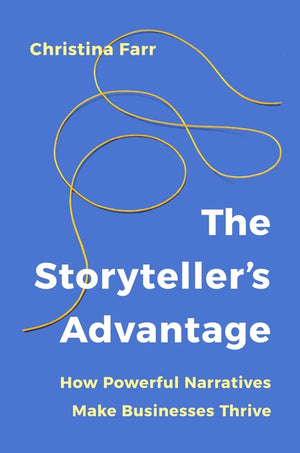
An excerpt from The Storyteller's Advantage by Christina Farr, published by Basic Venture and longlisted for the 2025 Porchlight Business Book Awards in the Innovation & Creativity category.
 For decades, the business world has been content with leaders who drive profits and make strategic decisions. But in today’s ultracompetitive world, that is simply not enough. The ability to tell a compelling story about your product or service is no longer just a competitive advantage—it’s a requirement.
In The Storyteller's Advantage, investor, startup advisor, and former business journalist Christina Farr reveals the secrets of business leaders who inspire, entertain, and empathize through the art of storytelling. Farr offers an inside look at the greatest storytelling CEOs, whose narrative abilities enable them to raise more capital, retain more talent, and make their brands more memorable. With empirical research and candid commentary, Farr explores how these leaders developed their stories, breaks down the narratives that are resonating in today’s workplaces, and shares practical advice on how to deliver the most compelling message.
Practical and approachable, The Storyteller’s Advantage will help any business leader to tap into their ultimate superpower—telling a great story.
The Storyteller's Advantage has been longlisted in the Innovation & Creativity category of Porchlight Book Company's 2025 Business Books Awards. The excerpt below is from the book's Introduction.
◊◊◊◊◊
The Effect of Being Transported
Have you ever been in the presence of a truly great storyteller? Looking back on those experiences where I’ve encountered one, I can recall the most minor details, including what restaurant we sat in, if it was raining, or what I wore that day. The exceptional storytellers I’ve interacted with include founders, senior executives, and CEOs, like Jensen Huang, CEO of Nvidia; Anne Wojcicki, CEO of 23andMe; Aaron Levie, CEO of Box; and Alexis Ohanian, founder of Reddit.
The first time I met Ohanian, at the South by Southwest conference in the early 2010s, I was a junior reporter at VentureBeat in my early twenties. I can still recall how crowded the bar was, the smell of beer mingled with sweat in the ninety-degree heat, and the hour I stood in the line to get in.
In our first one-on-one conversation, he shared the story of the original idea for Reddit: A food-ordering app he created with his friend and roommate, Steve Huffman, while they were at college together. That idea proved to be a bad one; it went nowhere. But he told me how a fruitful meeting with technology investor Paul Graham set the early team off in a new direction to create “the front page for the Internet.” That story nestled into my brain, as did many of the other anecdotes he shared, taking up permanent residence there. What was so effective was the vulnerable admission from Ohanian that his original idea had bombed. It made him unique, given that most people I met with in those days described their path as a series of unstoppable wins. It also made him human. Ohanian’s story intrigued me, and we spent a couple hours chatting and hanging out.
That was one of my first professional encounters with a great storyteller, and it stuck with me. There’s a reason Apple cofounder Steve Jobs, a skilled public speaker, once described the storyteller as the “most powerful person in the world.” Most of us tune out when we feel pitched, but we become far more alert when we are in the presence of a good storyteller. We have all faced hardships and challenges. Hearing those stories from others reminds us of what we share, helping us form meaningful relationships in the process.
“You have to use stories when you’re trying to inspire people,” said Anne Wojcicki of 23andMe, a company that has sold at-home health and genetic tests to millions. Storytelling is a tool for companies to stand out at pivotal moments, including those inevitable hard times. Wojcicki has been through plenty of those. She’s lost key customers, faced cyberattacks, handled pushback from federal regulators, had board members publicly quit, and weathered drastic fluctuations in her company’s stock. She gets through all of that with the help of storytelling.
It has also had a direct impact on the metrics that matter to her and her business, which has reached some incredibly high highs and low lows (as of the end of 2024, Wojcicki is embroiled in a public battle to take her company private). One particularly important one: 42 percent of the company’s employees have stuck around for at least five years, while an additional 4 percent have “boomeranged,” meaning they have left the company and come back. The industry norms for a company of this stage and size is a tenure of less than four years.
Wojcicki said that when she senses her team needs to feel motivated or inspired, she tells them a story. One of her favorites involves a 23andMe user who discovered via one of her company’s tests that she was part Inuit. That woman was so touched that she quit her job and moved to the Arctic Circle. Three years later, she emailed 23andMe to say she had “found her true calling.” This story also served as a not-so-subtle nudge that the team better not mess up when it comes to delivering test results: An inaccurate one could change someone’s life in profound and potentially irreversible ways. But it was also a reminder that people take these tests incredibly seriously, and therefore the job of someone working at 23andMe mattered—at the very least, to this subset of users.
When all else fails, Wojcicki also tackles tough questions with her trademark humor and wit, another key component to good storytelling. When journalists called about the termination of a lucrative partnership after a sixteen-year run, Wojcicki shot back, “Would your teenager go for another sixteen years with mom?”At the core of good storytelling lie humor, authenticity, simplicity, and surprise. This is easier said than done. I’ve personally read thousands of websites across every industry over the years, and the biggest compliment I can muster for many of them is “dry.” The reality is that most of them are barely comprehensible. That’s disappointing because, as the saying goes, there’s only one chance to make a good first impression. Are companies doing that with a “solution” that “integrates with workflow in the cloud”? And don’t get me started on the overuse of the word “platform” on corporate websites (what’s wrong with just calling it what it is, such as an “app” or a “website”?). There are countless moments in the corporate world when brands could build strong connections to their customers and other key stakeholders but fail to do so. We’ll discuss some of the most common marketing myths and misconceptions driving so much of this bland and emotionless copy—which I refer to as “corporate speak”—and how we can do better.
We Have Always Been Storytellers
Somewhere along the way, we’ve lost touch with the storytelling aspect of our fundamental nature. Human beings have always thrived on narrative, not on a stream of facts or statistics—and certainly not on corporate jargon.
Studies show that stories are powerful because they forge connections between diverse communities and because they convey culture, history, and values. Uri Hasson, a professor in the Department of Psychology and the Neuroscience Institute at Princeton University, has scanned people’s brains to understand how we respond to hearing stories. He has learned that when told well, stories act as a bridge between people who might start out with different mindsets. As he put it, “If you start to get me, your brain starts to be similar to mine. . . . And if you really get me, we become more and more similar in our brain responses.” In one study, Hasson and his team recorded brain activity in pairs of subjects as one told a story and the other listened. The greater the listener’s comprehension, Hasson found, the more the two brains started to sync. The scans showed that high-functioning areas of the brain, such as the frontal cortexes, became even more aligned when the stories came from real life.
Hasson told me that storytelling is most effective when people “click,” which most often happens when the storyteller throws out the script and focuses instead on connecting with their audience. As he tells his own students, that does not mean winging it without any preparation. Hasson encourages his students to put themselves in the shoes of listeners or viewers and think about why they should care. “The audience wants to learn something, but there needs to still be a story with a beginning, middle, and an end,” he explained.
As neuroscientists have found, stories are also powerful because they can stimulate parts of the brain associated with making predictions, which in turn encourages cooperation between two or more individuals. That cooperation occurs when neurochemicals are released in the brain, such as oxytocin, which is associated with feelings of trust, empathy, and reward. There’s a reason why narratives are so helpful in inspiring people to donate to charity, for instance. They help us feel more connected to an individual or species or geography, even if we aren’t directly experiencing negative impacts. And there’s a growing body of evidence via brain-imaging studies that storytelling is strongly linked to memory, which explains why I was able to recount details of that meeting with Ohanian years later. For these reasons, storytelling can also become an ethical liability, as it can be used for good or for evil. In Part 3, we’ll discuss how the CEOs of notorious companies like FTX and Theranos used their storytelling skills to perpetuate fraud and got away with it for years.
If CEOs were aware of the power of storytelling, no business would be reduced to jargon and slideware. Neuroscientists like Paul Zak, who teaches at Claremont University, now advise all CEOs—regardless of the stage and size of the business—to lead with a powerful story that includes some moment of setback to increase tension—and to do that before launching onto any deck. “In terms of making an impact,” he writes, “this blows the PowerPoint presentation to bits.”
Excerpted from The Storyteller's Advantage: How Powerful Narratives Make Businesses Thrive by Christina Farr, published by Basic Venture. Copyright © 2025 by Christina Farr. All rights reserved.
About the Author
Christina Farr is a health-technology investor, advisor, and industry expert. She is a managing director at Manatt, where she advises companies in narrative development with a specialization in fundraising; a general partner at Scrub Capital; and editor-in-chief of the popular newsletter and podcast Second Opinion. She is a regular guest on APM Marketplace, former co-chair for Fortune Brainstorm Health, and a Top Voice for technology on LinkedIn. She lives in New York with her family and grew up in London, UK.